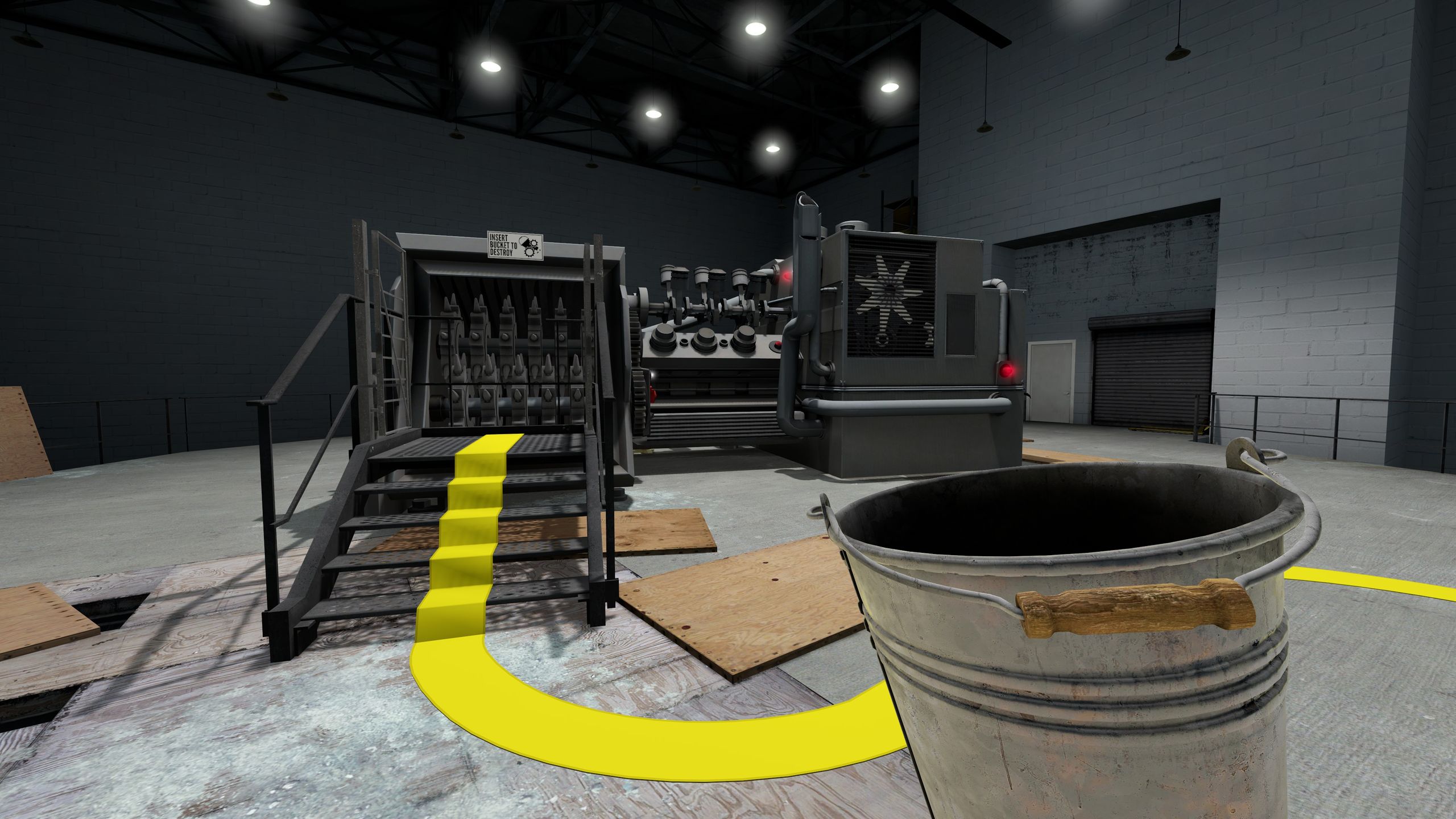
More on yellow paint: Are you a "yellow paint" hater?

Zed Clampet

Community Contributor

Everything I try to post lately has already been posted, but this is relevant again thanks to a couple of new PC Gamer articles:


As far as yellow paint on ledges go, I could live without it if developers were better at making the ledges look climbable. Otherwise, I end up hopping up and down all over the place trying to climb up things that aren't climbable. The idea that climbable ledges could just look more climbable is kind of echoed in this paragraph from the first article:

Final Fantasy 7: Rebirth's director Naoki Hamaguchi stated there is "definitely a need for that kind of thing" in games, even if players don't like it, while The Witcher 4's lead designer believed the problem "isn't necessarily the yellow paint", but the context in which it was used, and that level designers needed to "properly weaponise the entire arsenal of your toolkit" to prevent players from realising that "'oh, I'm being guided'".

It's kind of like lighting. If you are navigating a complex area for the first time and you see that one area is lit up, you know that's where you are supposed to go. That's a lot more natural than yellow paint. As far as climbing goes, some games use more natural signals, like covering an area with vines.

The fist article mentioned Fable 2's dog who would help you find the right way to go, and I've had companions in some games, Naughty Dog games come to mind, who will wait for you to look around, and if it appears that you are lost, the companion will say something like "over here!". I think that's a pretty good system. Let you give it a shot, but bail you out if you stall.

Any suggestions for helping players navigate? Or should there be no help?
 

Frindis

Painted Wife Yellow So I Can Find Here Shopping
Moderator
I'm fine with a bit of guidance in games with more complex mechanics, something like Mirror's Edge as an example, but I find it kind of stupid to have it in games like Far Cry and similar easy to understand games. These type of visual clues kind of makes me think that developers look at us players as dumb as rocks. @Zed Clampet I do see the point of the climbing on non climbing stuff issue, but that is also more a developer problem, than it is us needing guidance.

Call of Duty Verdansk Battle Royal map had this problem with some areas not climbable, but it was not really any problem because we did not need yellow paint to figure out that if the areas was to steep or had particular rocks, then it would not work. So, could have been better, but amazingly enough we managed to get it.

I can understand having more prominent clues back in the 90's, because that was an area with a lot of new genres and different ways to navigate and use objects in the world, like you have with the Half Life or the first portal game (the latter from 2007 though). People needed a little help because it was something new, but nowadays the majority of us know how to understand simple game mechanics and I don't see much point in guiding us with yellow paint or similar visual clues, if not for just having us zoom through an area without thinking.

I'd also like to throw in another example. In Guild Wars 2 there are jumping puzzles and some fairly complex. They didn't have any visual clues from what I remember, so you had to use logic and miss and fail to get around some of the harder obstacles. That was both fun and at times frustrating, but that was what made it a challenge. With yellow paint, you would completely destroy the challenge and it would have become mindbogglingly easy to do.

I also have to mention: We already have so many different clues in games coming from waypoints, text, icons, sounds, images and you name it, it can be ridiculous in some games, so you have to turn them off and even then, in some games you still can't remove them all. I think this just points out the obvious, that either us humans have become dumber or we can think for ourselves and actually find the idea of exploring fulfilling, even if that would mean we won't be able to climb a bloody hillside since we don't have the horse from Skyrim.
 
Last edited:

Frindis

Painted Wife Yellow So I Can Find Here Shopping
Moderator
I like playing games without it completely once in a while. I'm not against direction in games, but a middle ground without yellow paint levels of obviousness is my favourite.
Metro Exodus on Stalker difficulty I thought did it quite well. I belive you had a marker on the map as to where approximately to go for quest related objects, but that was about it. As for using items or finding them, you had to use your eyes, which also made it a bit more fun to explore and with more immersion.

Another game I was thinking about was Morrowind. That game was sooo great because you did not even have a quest marker, you only had a text objective to go somewhere and the rest was up to you. How cool isn't that? That game is still one of the absolute OG's when it comes to no handhelding and making you love finding stuff out, like if you were on a real adventure.

I still miss that amazing feeling of walking on a dark road with a torch and hearing the ambient sounds of monsters and only having a slight bearing as to where the city Balmorra was, with nothing on the map explored. Obviously you don't stay on the road for long, so suddenly you'll find yourself in some crypt running for your lives! It's a fantastic game for just letting you explore and learn for your own.
 
Last edited:
yes whilst insulting and yes obvious that it ruins immersion i say we're better for it. Especially when it comes to navigation, flow and just playability. There's nothing worse losing momentum, flow and getting lost in a game and especially when its ambiguous as to where to go next. even the insulting navigation system with obj markers on a map are preferred to nothing.

Most good level designers use a variety of tricks, like lighting, various textures, linear pathways or a combination of the above and more to make sure the levels play properly. I argue that the best non linear level design are ones with linear elements ingrained into it especially when it comes to metroidvanias. Perhaps for the "yellow paint" feature perhaps nothing too obvious as masses amount of yellow paint unless it was used to decorate hazard lines on a platform or ledges in an industrial park or urban setting. if we use yellow paint its going to be tough to justify it.

the witcher 3 had a pretty good balance. You were told roughly where it is and after that you used your witcher powers to track and follow the bread crumbs. it was immersive, simple and made sense.
 

Zloth

Community Contributor

Well, I'm doing a lot of cliff climbing in Dragon's Dogma 2 right now. It does a pretty good job of it, too.

Personally, the visual clues I want to see are the cliff itself. Computers are going to be hyper precise, so if the slope is less than X you can climb but any more, even a fraction of a degree, and you can't. You can reach up Y meters, but one millimeter more and there's no chance. So, when designing your cliff you've got to keep reasonably far away from X slope and Y distance between handholds. I'll figure out those break points myself with some trial and error. Then you can start messing with my mind by dimming the lights and whatnot.

However, that is going to take me some time to go through. If this is some fast-paced game where I'll be spending a lot of time running after/from evil whatnots, put your development time into something else and just paint a yellow line. Figuring out what amounts to a vertical maze is not something I want in a game of Doom. Tomb Raider, on the other hand....

If you are navigating a complex area for the first time and you see that one area is lit up, you know that's where you are supposed to go.
To me, it registers more as 'the place I will eventually be forced to go.' ;)
 
  • Like
Reactions: Pifanjr and Frindis

Frindis

Painted Wife Yellow So I Can Find Here Shopping
Moderator
Come to think of it, the early Assassin's Creed games did the climbing quite well. From what I remember the only real visual clues were stuff like a hay for knowing where to jump, though most large buildings had something like that scattered nearby.

In the older ones you could climb just about anything and while climbing steep wall was not realistic by any means, it definitely helped with the fluidity. So again, having yellow markers and that kind of more obvious handhelding seems for me to be more a developer problem not been solved, than a necessity if the game is not very intricate and even then, you use something less obvious like what @Johnway mentioned.

Since @Johnway mentioned Metrovania games, I wanted to throw in Bloodstained: Ritual of The Night as example of doing the exploration aspect quite well. There was not only subtle hints (lights, etc) as where to go, but whole map areas basically function as a larger clue as to where to go, like if you noticed different cogs turning from one direction, you knew where to go next.
 
  • Like
Reactions: Pifanjr
Come to think of it, the early Assassin's Creed games did the climbing quite well. From what I remember the only real visual clues were stuff like a hay for knowing where to jump, though most large buildings had something like that scattered nearby.

Yeah, the old Assassin's Creed games had pigeons with some hay on ledges where you could jump off to land in a hay bale, which worked great.

I think it's fine to make it obvious where a player can or cannot climb, but do that by making the climbable surface stand out overall, instead of making it blend in with the environment and then slapping some paint on it so it stands out anyway.

And if you're really worried players might miss it anyway, add a button that lights up interactive elements. If you want you can flavour it, like the Witcher powers Johnway mentioned.
 

TRENDING THREADS